| Generic Name: |
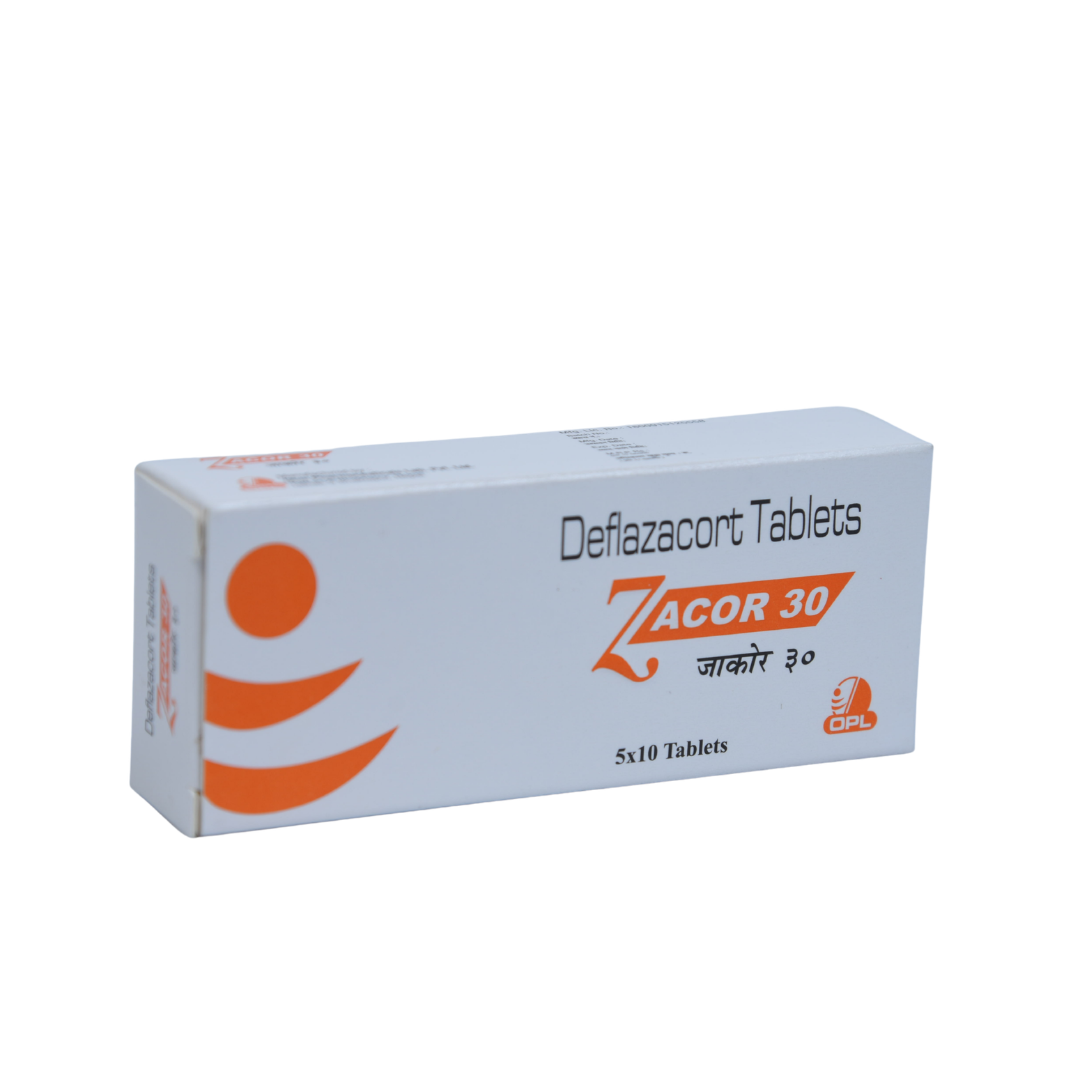
Deflazacort
|
| Therapeutic Category: |
Glucocorticoids
|
| Pharmacological Class: |
Corticosteroids
|
| Composition: |
Each uncoated tablet contains:
Deflazacort 6 mg tablets
Deflazacort 30 mg tablets
|
| Pregnancy Category: |
X
|
| Lactation: |
Contraindicated
|
| Presentation: |
5X10’s
|
| INDICATIONS: |
- Duchenne Muscular Dystrophy (DMD).
- Rheumatoid arthritis.
- Juvenile chronic arthritis.
- polymyalgia rheumatica.
- Bronchial Asthma
|
| MECHANISM OF ACTION: |
Deflazacort is a glucocorticoid. Its anti-inflammatory and immunosuppressive effects are used in treating a variety of diseases and are comparable to other anti-inflammatory steroids.
|
| DOSAGE: |
For acute disorders, up to 120 mg/day deflazacort may need to be given initially. Maintenance doses in most conditions are within the range 3 – 18 mg/day. The following regimens are for guidance only.
Rheumatoid arthritis: The maintenance dose is usually within the range 3 – 18 mg/day. The smallest effective dose should be used and increased if necessary.
Bronchial asthma: In the treatment of an acute attack, high doses of 48 – 72 mg/day may be needed depending on severity and gradually reduced once the attack has been controlled. For maintenance in chronic asthma, doses should be titrated to the lowest dose that controls symptoms.
|
| Allergic and inflammatory disorder: |
Adult:
Initially, upto 120mg daily.
Maintenance: 3 -18 mg/day
Child:
0.25 – 1.5 mg/kg/day given on alternate days
Duchenne Muscular Dystrophy
Under 5 years:
Safety and efficacy not established
Above 5 years:
0.9 mg/kg/day once orally everyday
|
| PHARMACOKINETICS: |
Absorption
Orally administered deflazacort appears to be well absorbed.
Distribution
The active metabolite D 21-OH achieves peak plasma concentrations in 1.5 – 2 hours. It is 40% protein-bound and has no affinity for corticosteroid-binding-globulin (transcortin).
Biotransformation
Orally administered deflazacort is immediately converted by plasma esterases to the pharmacologically active metabolite (D 21-OH). Metabolism of D 21-OH is extensive. The metabolite of D 21-OH is deflazacort 6-beta-OH.
Elimination
Its elimination plasma half-life is 1.1 – 1.9 hours. Elimination takes place primarily through the kidneys; 70% of the administered dose is excreted in the urine. The remaining 30% is eliminated in the faeces. Metabolism of D 21-OH is extensive; only 18% of urinary excretion represents D 21-OH. The metabolite of D 21-OH, deflazacort 6-beta- OH, represents one third of the urinary elimination.
|
| ADVERSE EFFECTS: |
- The adverse effects are weight gain, headache, vertigo, osteoporosis, vertebral and long bone fractures, depressed and labile mood, behavioural disturbances.
|
| CONTRAINDICATIONS:: |
- Hypersensitivity to the active substance, deflazacort or any of the excipients.
- Systemic infection unless specific anti-infective therapy is employed.
- Patients receiving live virus immunization.
|
| PRECAUTIONS: |
The following clinical conditions require special caution and frequent patient monitoring is necessary:
- Cardiac disease or congestive heart failure (except in the presence of active rheumatic carditis), hypertension, thromboembolic disorders. Glucocorticoids can cause salt and water retention and increased excretion of potassium. Dietary salt restriction and potassium supplementation may be necessary.
- Gastritis or oesophagitis, diverticulitis, ulcerative colitis if there is probability of impending perforation, abscess or pyogenic infections, fresh intestinal anastomosis, active or latent peptic ulcer.
- Diabetes mellitus or a family history, osteoporosis, myasthenia gravis, renal insufficiency.
- Emotional instability or psychotic tendency, epilepsy.
- Previous corticosteroid-induced myopathy.
- Liver failure.
|
| DRUG INTERACTIONS: |
- The desired effects of hypoglycaemic agents (including insulin), anti-hypertensives and diuretics are antagonised by corticosteroids and the hypokalaemic effects of acetazolamide, loop diuretics, thiazide diuretics, beta 2-agonists, xanthines and carbenoxolone are enhanced.
- Co-treatment with CYP3A inhibitors, including cobicistat-containing products, is expected to increase the risk of systemic side-effects. The combination should be avoided unless the benefit outweighs the increased risk of systemic corticosteroid side-effects, in which case patients should be monitored for systemic corticosteroid side-effects.
|